

Hiking Boots vs Trail Shoes: Which to Buy for UK Trails?
Stand on a Lakeland path and ask ten walkers whether boots or trail shoes are better. You will get ten confident answers, quite possibly delivered while one of you sinks to the ankle in peat. Both are good. They are simply good at different things, and the question worth asking is not which one wins but which one suits the walking you actually do.
British ground makes that harder to answer than it looks. A single Saturday can serve up a stone track, a bog, wet grass, a granite slab, two stiles and half a mile of tarmac at the end. Compare the two types where it counts — grip, waterproofing, ankle support and comfort — and the choice usually makes itself.
Where you walk matters more than what you wear
Before comparing specs, run a quick audit of your last ten walks. Distance, ascent, surface, and how wet your feet ended up. Most people spot a pattern straight away. Lowland paths, forest tracks, coastal clifftops and dry summer ridges point towards trail shoes. Peat hags, scree, wet heather and winter hills point towards boots. The awkward middle — most of Britain, in other words — is where you have to make a judgement call.
Grip: lugs, rubber and the mud problem
Trail shoes commonly have lugs around 4–5 mm; boots can go deeper and more aggressive. Depth matters less than spacing. Widely spaced lugs shed mud as you walk, which is why a February bridleway can feel more secure under a shoe than under a smooth-soled boot. Closely packed lugs grip better on rock but clog quickly, and once they are packed with clay they slide.
The rubber compound matters just as much. Softer, stickier rubber holds on wet gritstone and slate; harder compounds last longer but skate about. Neither type grips well on wet grass, wet wooden boardwalks, wet limestone or polished rock. On those surfaces, shorten your stride, use trekking poles and accept that everyone else is sliding too.
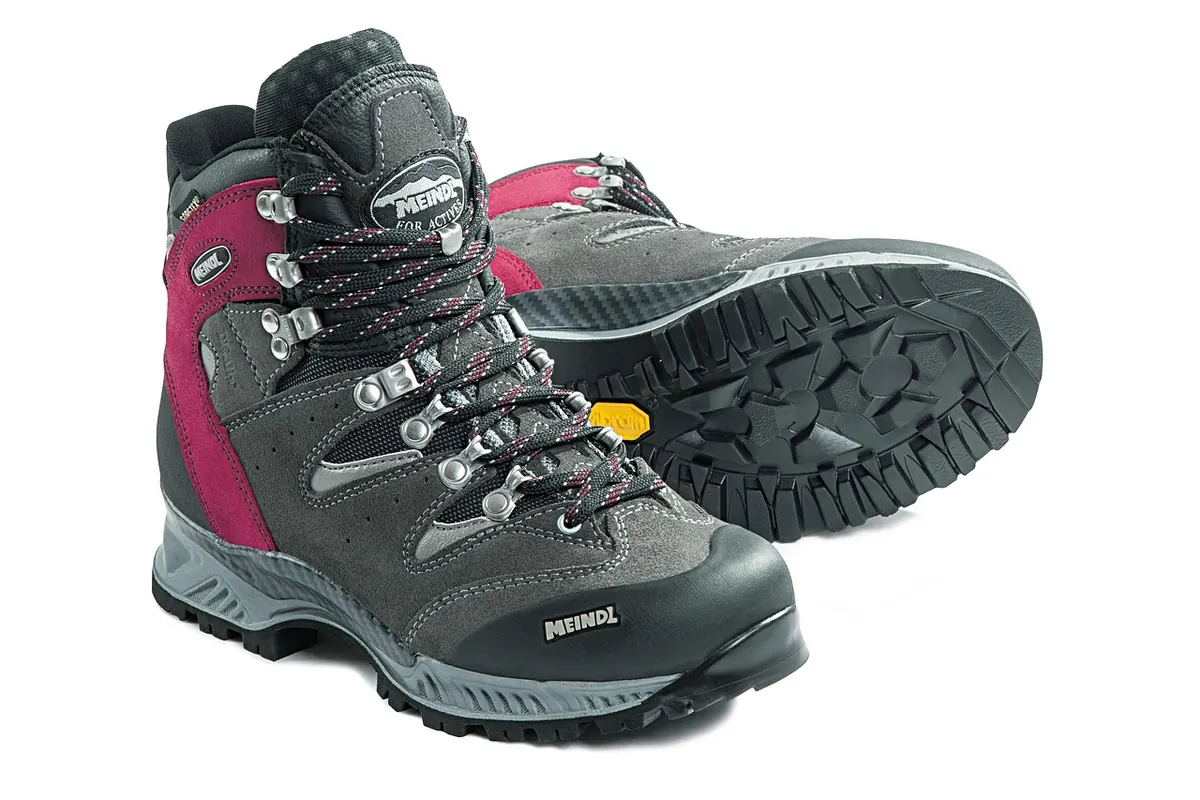
One thing boots do offer is a stiffer sole, which protects your feet from sharp stones and scree and supports you when you are carrying weight. That stiffness has a downside: a rigid boot rolls over small holds rather than moulding to them, so on rocky ground a flexible shoe can feel more precise.
Waterproofing: a trade-off, not a win
A waterproof membrane keeps water out. It also keeps sweat in, and once water comes over the top of the collar — a stream crossing, a deep puddle, a bog — a lined boot can take a long time to dry. Mesh trail shoes are the opposite. They get wet within minutes in long grass, then drain and dry while you walk. On a warm, showery day that is often more comfortable than a clammy waterproof boot. On a cold, wet day on high ground it is a genuine safety consideration, because wet feet lose heat quickly.
A practical compromise
- Waterproof boots for winter, bogs and multi-day walks where cold, soaked feet become miserable.
- Mesh shoes for summer, dry paths and anything fast.
- Waterproof socks, worn with either, for days when the water is unavoidable.
- Gaiters to stop heather, grit and water going over the top of a low shoe.
Both need looking after. Mud left to dry on the upper cracks leather and breaks down glue, so rinse them, dry them slowly away from a radiator, and reproof leather when it stops beading.
Ankle support: what a boot really does
A high collar adds protection from rocks, heather and thorns, and it gives the ankle something to push against. It does not, on its own, prevent a roll on uneven ground. Sole stiffness and a secure heel fit do more for stability than cuff height, and a badly fitting boot is worse than a well-fitting shoe.
Boots come into their own with a heavy pack, on scree, and in winter, when crampons need a stiffer sole and often a welted boot to match. If you have a history of ankle sprains, persistent heel or arch pain, or a diagnosed foot condition, speak to a physiotherapist or podiatrist before spending money on footwear. General advice is no substitute for someone looking at your feet.
Comfort, fit and fatigue
Weight on your feet costs you over a long day. On a ten-mile walk with 600 metres of ascent, lighter footwear is easier on the legs, particularly on the climbs, and many people find they finish fresher. That is an argument for shoes on dry, rolling ground — and an argument for a lighter boot rather than a heavy one on everything else.
Fit beats every spec on the box:
- Heel lock: your heel should sit back and stay put when you lace up and walk on a slope.
- Toe room: a thumb's width in front, with no pinching across the widest part of your foot.
- Socks: try footwear on with the socks you will actually wear — a wool or synthetic blend, not cotton.
- Timing: feet swell during the day, so shop late afternoon if you can.
Break boots in gradually with a few short walks before a big day out. Blisters come from movement and moisture rather than newness, so if you feel a hot spot, stop and deal with it there and then.
Matching footwear to the walk
- Lowland paths, forest tracks, towpaths: trail shoes.
- Chalk downland and dry limestone ridges: trail shoes, or a light boot if it has been wet for days.
- Coastal path: shoes in summer; boots in winter, when the mud is relentless.
- Peat moorland, bogs and wet heather: boots, or shoes with waterproof socks and gaiters.
- High fell, scree and long descents: boots with a stiffer sole.
- Winter hills and crampons: a stiffer boot that matches the crampon you use.
- Multi-day with a heavy pack: boots, unless you are travelling light and confident in shoes.
How to decide
If you only want one pair, choose a lightweight fabric boot or a burlier trail shoe with a rock plate, and accept the compromise. If you are building a kit over time, buy for the walking you do most, not for the most extreme day you have planned.
- Go late in the day, with your usual walking socks.
- Try both types on the same visit and walk on the shop's ramp if there is one.
- Check heel lock on the slope and toe room on the flat.
- Ignore the label on the tongue. A comfortable shoe you wear all summer beats an expensive boot that rubs.
Then get out and use them.
Photo: stux / Pixabay